

VINTAGE FLOWERVASE
LIGHT GLASS-27 NR-KR-199 Lauscha VINTAGE FLOWER VASE
A beautiful flower vase created from Lauscha blown glass.
Unique as an objet d'art, its delicate appearance is one-of-a-kind.
It possesses both fragility and strength.
Manufactured between the 1960s and 1970s.
Country of Origin: Germany
Material: Glass
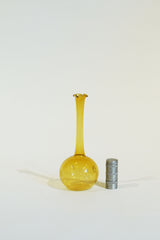
Height...22cm
Width...9cm
Caliber...3cm
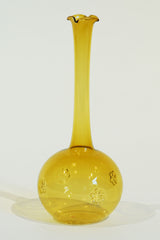
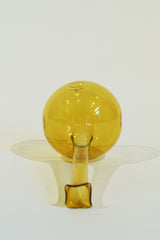
Please check the photos for size and product condition.
This is a beautiful flower vase made by Lauscha Glass in East Germany, with a lovely yellowish-green hue.
It features a distinctive mouth and a rounded, elegantly curved crane-neck shape on the body with a petal pattern.
Its sophisticated design is impressive.
Lauscha is a small glass town nestled in the Thuringian Forest in eastern Germany, where people have lived and made glass for over 400 years.
In East Germany, industry had its own unique system, with state-owned enterprises called VEB (Volkseigener Betrieb or "People's Own Enterprise") established in various regions, and different industries in each area.
This product is a thin, delicate glass vase made by a glassblower in Lauscha, Thuringia, a region known for its thriving glass industry, between the 1960s and 1970s. Its streamlined, futuristic form offers a glimpse of the Space Age design popular at the time.
Although it cannot be definitively confirmed due to the lack of a stamp, based on the style, it is possibly the work of the renowned glass artist Albin Schaedel, or from his workshop.
Albin Schaedel
Albin Schaedel
Schaedel was an innovative Thuringian glass artisan with an international reputation.
He came from a family with a 200-year tradition of glassmaking. His father was a lampwork artist. He worked as a glass bead maker in his father's workshop, starting his apprenticeship in 1924, and from 1927 he became a craftsman under Edmund Müller in Neuhaus. From 1934, Schaedel worked as an independent art glassblower. From 1934 to 1938, he attended Professor Karl Staudinger, a painter and graphic artist, in Sonneberg. In 1937, he participated for the first time in the arts and crafts fair in Leipzig.
From 1940 to 1945, Schaedel was a soldier. In 1949, he was awarded a quality seal for arts and crafts. In 1952, he passed his master's examination and was recognized by the examination board of glassblowing masters and the Association of Visual Artists. In 1954, Schaedel moved his apartment and workshop to Arnstadt, "his second home." In 1980, he had to stop working in front of the glass flame due to health reasons.
Schaedel was a highly experimental glass artist. He refined and developed assembly techniques ("skull technique") for works such as the design of vessels blown in front of a lamp, applying them to sophisticated art. He was one of the most productive and influential glass artists of his time.
He participated in numerous solo and group exhibitions at home and abroad. Among others, he took part in five German art exhibitions and East German art exhibitions held in Dresden from 1958 to 1978.
━━━━━━━━━━━━━━━━
━━━━━━━━━━━━━━━━
※As this is a vintage item, there may be small scratches or dirt. Please purchase after acknowledging this.
※While we strive to photograph and process product photos to be as close to the actual color as possible, the actual product color may differ depending on your monitor settings and room lighting.